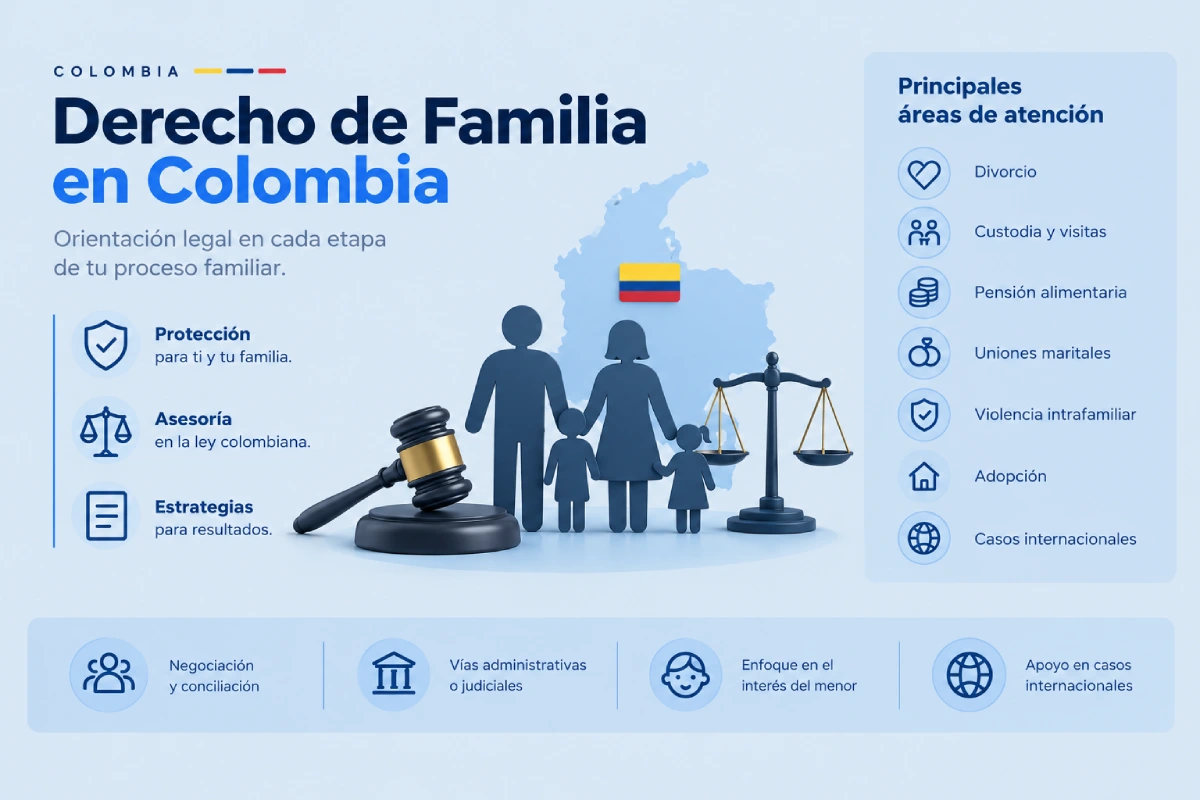
When parents separate, one of the most important legal questions is who will be responsible for the child’s day-to-day care and how that responsibility will be organized. In Colombia, custody is closely connected to the child’s right to receive appropriate care, protection, education, and support from the people responsible for raising them.
For parents searching for Child custody in Colombia requirements, it is important to understand that Colombian family law does not determine custody simply by considering which parent requests it first or which parent has a stronger financial position. Authorities must examine the circumstances of each individual case and prioritize the child’s best interests, protection, and fundamental rights. The Instituto Colombiano de Bienestar Familiar (ICBF) expressly states that custody decisions must be made according to the specific facts of each case and with the child’s welfare and rights as the central consideration.
Custody can be established through an agreement between parents, through an administrative process in circumstances involving the protection of the child’s rights, or through a judicial proceeding when the parents cannot reach an agreement. The appropriate route depends on the circumstances of the family.
This article explains the Child custody in Colombia requirements parents should understand, including the documents commonly requested, the available procedures, the role of the ICBF and family judges, the difference between custody and parental authority, international situations, visitation, child support, modifications, and important considerations for parents living outside Colombia.
What custody means under Colombian family law
In Colombia, custody refers primarily to the physical care and direct day-to-day responsibility for a child. The ICBF describes custody as the physical possession and personal, direct care of a child or adolescent. It is considered both a right of children and an obligation of their parents or legal representatives.
This means custody is not simply a question of where a child sleeps at night. It encompasses the practical responsibilities involved in raising a child, including supervision, education, protection, guidance, and daily decisions related to the child’s welfare.
When parents live together, these responsibilities may be exercised jointly without requiring a formal custody order. When parents separate, however, it may become necessary to establish who will have primary care, how the child will spend time with each parent, and how financial responsibilities will be handled.
Custody is focused on the child’s daily life
A custody arrangement can determine where the child primarily lives, who provides daily supervision, how school-related responsibilities are managed, and how the parents coordinate the child’s routine.
It does not automatically mean that the parent without physical custody loses parental rights or stops being responsible for the child.
The ICBF specifically explains that a parent who does not have custody does not lose their relationship with the child or their responsibilities concerning upbringing and education.
Custody and parental authority are different
One of the most important Child custody in Colombia requirements concepts is understanding the difference between custody and parental authority, known in Colombian law as patria potestad.
Custody concerns daily care and personal responsibility. Parental authority involves a broader set of legal rights and obligations concerning the child, including legal representation and certain matters involving the child’s property.
The Ministry of Justice similarly emphasizes that custody should not be confused with parental authority.
Therefore, receiving custody does not automatically make one parent the sole legal authority over every aspect of the child’s life.
The best interests of the child are central
Colombian authorities do not determine custody simply by applying a mechanical checklist. The circumstances of the individual child and family must be evaluated.
The ICBF states that the competent authority must analyze the specific facts of each case under the applicable law and make a decision based on the child’s welfare, comprehensive protection, best interests, and the prevalence of the child’s rights.
This principle is fundamental when considering Child custody in Colombia requirements because it means that evidence and circumstances can be more important than assumptions about which parent should automatically receive custody.
What authorities may consider
Depending on the circumstances, authorities may examine issues such as:
- The child’s current living conditions.
- The ability of each parent to provide appropriate care.
- The child’s educational situation.
- Health and medical needs.
- Emotional and family relationships.
- The stability of the child’s environment.
- The presence of supportive relatives.
- Any allegations affecting the child’s safety.
- Each parent’s willingness to support the child’s relationship with the other parent.
- The child’s own views when appropriate to their age and maturity.
There is therefore no universal formula that guarantees custody to a particular parent.
Child custody in Colombia requirements for parents
Parents who want to establish custody should understand that the process normally involves identifying the child, the parents, the existing family circumstances, and the arrangement being requested.
The ICBF identifies several documents commonly presented in a custody proceeding. These include the identification documents of the parties, a copy of the child’s civil birth registration, and an identification card for children older than seven where applicable. Other documents that a parent wants to use as evidence may also be submitted.
Importantly, the ICBF states that the absence of these documents cannot be used as a condition to deny initial attention.
Identification documents
Parents or other interested parties should generally be prepared to provide identification documents.
For Colombian citizens, this may involve the applicable citizenship identification document. In cases involving foreign parents, additional documentation may be relevant depending on the circumstances.
The child’s birth registration
The child’s civil birth registration is an important document because it establishes the legal parent-child relationship and provides basic identifying information.
It is commonly requested in family proceedings involving custody and other parental responsibilities.
Additional supporting evidence
The basic documents are not necessarily the only information that can be relevant. A parent may have evidence concerning the child’s education, health, housing, caregiving arrangements, or other circumstances.
The ICBF allows parties to present additional documents they consider relevant during the custody process.
Where can a parent request custody in Colombia
The appropriate location depends on the child’s residence and the procedure being pursued.
For the ICBF custody service, the official information indicates that parents, legal representatives, relatives, guardians, or people caring for the child can approach the corresponding ICBF zonal center based on the child’s place of residence.
This is an important practical point for anyone researching Child custody in Colombia requirements because the process generally begins with the child’s circumstances and location rather than simply the parent’s preferred city.
The role of the ICBF
The ICBF plays an important role in the protection of children and adolescents.
When parents seek to establish custody through an agreement, a Family Defender may summon the relevant parties to a conciliation hearing to determine the custody and personal care arrangement.
The ICBF can also intervene in situations where a child’s rights may be threatened or violated.
Other sources of legal assistance
The Ministry of Justice indicates that parents seeking information about custody may also approach the Family Defender’s Office, the ICBF, a municipal Personería, or a university legal clinic.
A family lawyer may also assist with preparing documents, assessing evidence, negotiating an agreement, and representing a parent when litigation becomes necessary.
Child custody in Colombia requirements when parents agree
When parents agree about custody, they may be able to resolve the issue through conciliation rather than beginning a contested court proceeding.
This can be particularly useful when both parents are willing to communicate and develop a practical arrangement that protects the child’s interests.
What a custody agreement can address
A well-developed agreement can establish matters such as:
- Which parent will have primary physical care.
- Whether custody will be shared.
- Where the child will primarily reside.
- How the child will spend weekends and holidays.
- How school vacations will be divided.
- How parents will communicate about education and healthcare.
- How transportation will be handled.
- How extraordinary expenses will be addressed.
- The applicable child support arrangement.
- Procedures for handling future changes.
The more clearly these matters are addressed, the less room there may be for future disagreements.
Why informal agreements can create problems
Parents sometimes establish arrangements verbally and continue following them for years. While cooperation can work for some families, informal arrangements may become difficult when one parent later changes their position.
A formally documented agreement can provide greater clarity concerning each parent’s responsibilities.
When parents cannot agree on custody
Not every family can reach an agreement. Disagreements may involve where the child should live, school arrangements, travel, communication, financial responsibilities, or concerns about the other parent’s caregiving.
When parents cannot agree, Colombian law provides mechanisms through which custody can be determined.
The ICBF identifies three general routes for determining custody: conciliation when the parties agree, an administrative process for the restoration of rights when a child’s rights are not adequately protected, and a judicial process in which a family judge makes the decision after the required conciliation stage.
Judicial custody proceedings
When the matter reaches a family court, both sides may present information and evidence relevant to the child’s circumstances.
The Ministry of Justice explains that the judge can convene a hearing, receive the necessary evidence, hear the parties, and ultimately make the custody decision.
The court’s role is not simply to determine which parent has made the strongest personal argument. The decision must focus on the child’s protection and welfare.
Evidence that can be relevant in a custody dispute
One of the most practical Child custody in Colombia requirements considerations is understanding what information may help demonstrate a parent’s ability to provide appropriate care.
Evidence should be relevant to the child’s circumstances rather than simply designed to criticize the other parent.
Evidence concerning daily care
A parent may have information demonstrating their involvement in:
- School activities.
- Medical appointments.
- Homework and educational support.
- Daily transportation.
- Food and clothing.
- Extracurricular activities.
- Communication with teachers.
- General supervision.
This type of information can help establish the actual caregiving arrangements that have existed.
Evidence concerning living conditions
Information about housing and the child’s living environment may also be relevant.
The objective is not necessarily to demonstrate that one parent has a larger or more expensive home. Instead, the relevant question is whether the environment is suitable for the child’s needs and provides appropriate protection and stability.
Evidence involving safety concerns
If a parent raises concerns about abuse, neglect, violence, substance-related risks, or another issue affecting the child’s safety, the matter may require particular attention from the competent authorities.
Such allegations should be supported with reliable evidence whenever possible rather than presented solely as accusations.
Custody and the child’s relationship with both parents
A custody arrangement does not necessarily eliminate the child’s relationship with the parent who does not have primary custody.
The ICBF explains that a parent without custody continues to have responsibilities toward the child, including responsibilities related to upbringing and education.
This is why custody, visitation, and child support are often addressed together.
Visitation arrangements
A visitation schedule can establish when the child spends time with the other parent.
Depending on the circumstances, arrangements may cover regular weekends, weekdays, holidays, birthdays, school vacations, transportation, telephone communication, and other forms of contact.
The specific arrangement should reflect the child’s circumstances rather than being treated as a universal template.
What happens when visits are obstructed
The ICBF states that when the custodial parent prevents visits and the situation negatively affects the child, the competent authority may take measures to address the problem and, where necessary, reconsider the custody arrangement.
This demonstrates why custody decisions should be approached as part of a broader parental responsibility framework.
Child custody in Colombia requirements and child support
Custody and child support are separate legal issues, but they are closely connected.
The parent who does not live permanently with the child may still have a financial obligation to contribute to the child’s needs. Similarly, the parent who provides daily care contributes through housing, supervision, food, transportation, and other forms of support.
The Ministry of Justice recommends addressing custody, child support, visitation, and personal care together when custody is being established.
Custody does not eliminate financial responsibility
A common misconception is that the parent with custody receives exclusive responsibility while the other parent simply receives visitation rights.
That is not an accurate description of parental responsibilities.
Both parents can continue to have financial, educational, and parental responsibilities even when only one parent provides the child’s primary day-to-day residence.
Shared custody in Colombia
Shared custody can be considered when both parents are able to provide suitable care and cooperate in matters concerning the child.
The ICBF’s family-law guidance distinguishes between situations where one parent exercises custody and arrangements in which care is shared or alternated between both parents.
When shared arrangements may be considered
A shared arrangement may require practical coordination involving:
- School schedules.
- Transportation.
- Medical appointments.
- Homework.
- Extracurricular activities.
- Holidays.
- Communication.
- Travel.
- Child support and expenses.
The suitability of such an arrangement depends on the individual family circumstances.
Cooperation is particularly important
Shared custody can require significant communication between parents. If parents are unable to communicate about basic matters affecting the child, a complicated alternating schedule may become difficult to implement.
For this reason, custody decisions should consider not only the parents’ preferences but also the child’s actual needs and circumstances.
Custody and parental authority in Colombia
Parents researching Child custody in Colombia requirements frequently encounter the term patria potestad.
The two concepts should not be treated as interchangeable.
Parental authority includes legal rights and responsibilities associated with representation and the management of certain aspects of a minor child’s affairs. Custody, by contrast, is principally connected to the child’s personal and daily care.
The Ministry of Justice distinguishes these concepts and identifies custody as the permanent care of the child while describing parental authority as a different legal institution.
Does losing custody mean losing parental authority?
Not automatically.
The ICBF explains that assigning custody to one person does not change the child’s legal parentage. The parent remains the child’s parent even if another person has physical custody.
Loss or suspension of parental authority is a separate legal matter and requires the applicable legal procedure.
When a relative may receive custody
Parents are normally the primary people responsible for a child’s custody and care. However, there are circumstances in which another family member may receive custody.
The ICBF explains that grandparents or other relatives may be considered when parents are absent or when they cannot guarantee the child’s rights and appropriate care.
The importance of the family network
When a relative becomes involved in a custody arrangement, authorities may consider the child’s relationship with that person, the relative’s ability to provide appropriate care, and the overall family circumstances.
The objective remains the protection of the child rather than simply transferring responsibility from one adult to another.
Child custody in Colombia requirements for parents living abroad
International families can face additional complications.
A parent may live in the United States, Canada, Spain, the United Kingdom, or another country while the child remains in Colombia. Alternatively, the child and both parents may have moved between countries.
These cases may involve questions concerning jurisdiction, travel, recognition of foreign decisions, international service of documents, and cross-border enforcement.
Colombian custody proceedings involving an overseas parent
A parent living abroad should not assume that being outside Colombia automatically prevents them from participating in a custody matter.
The appropriate procedure depends on the facts, including the child’s habitual residence, the location of the other parent, existing Colombian decisions, and any applicable international instruments.
Because international family cases can involve more than one legal system, obtaining advice from a Colombian family lawyer familiar with cross-border cases can be particularly important.
International travel and custody
Travel is another issue that should be addressed carefully when parents are separated.
A custody arrangement may need to clarify how international travel will be handled, including advance communication, documentation, consent requirements, and the child’s return.
Parents should avoid assuming that a custody agreement automatically gives unrestricted authority to relocate a child internationally.
Can custody be changed later
Custody arrangements are not necessarily permanent for all circumstances.
The ICBF explains that custody has a temporary character because the circumstances that led to the original decision can change over time. A custody decision may therefore be modified through conciliation or a judicial custody proceeding when circumstances justify a change.
Circumstances that may justify review
A change may become relevant when there are significant developments involving:
- The child’s needs.
- A parent’s living circumstances.
- Educational requirements.
- Health conditions.
- Safety concerns.
- The parent’s ability to provide care.
- Changes in the child’s environment.
- The practical operation of the existing arrangement.
The existence of a previous custody order does not necessarily prevent a later review when circumstances materially change.
What happens when a parent violates a custody arrangement
Once custody has been established through an agreement, administrative decision, or court order, the arrangement should be respected.
The ICBF states that when a person has been granted custody but cannot continue caring for the child, they should not simply transfer the child to another relative without approaching the competent authority. The existing decision must be reviewed through the appropriate institutional process.
Unauthorized removal of a child
Colombian law also addresses situations where one parent takes, hides, or removes a child from the person legally exercising custody without consent.
The ICBF identifies this conduct under the concept of arbitrary exercise of custody and notes that it may have criminal consequences under Colombian law.
Because these cases can become urgent, parents facing a dispute involving the physical removal of a child should seek immediate legal guidance rather than attempting to resolve the situation through unilateral action.
Common mistakes parents make in custody cases
Understanding Child custody in Colombia requirements is useful, but parents should also understand what can complicate a case.
One common problem is treating custody as a competition between parents. Family proceedings are centered on the child’s rights rather than on determining which adult deserves to “win.”
Another problem is failing to document important circumstances. Parents may have relevant information about education, healthcare, housing, or daily care but lack organized records.
A third problem is confusing custody with parental authority. Receiving custody does not automatically eliminate the other parent’s legal relationship with the child.
Avoid using the child as a messenger
Parents should also avoid placing children in the middle of disputes whenever possible.
Messages about money, visitation, court proceedings, or disagreements between parents should generally be handled directly between adults or through the appropriate legal channels.
The child should not be required to choose sides.
How to prepare before requesting custody
A parent preparing to address Child custody in Colombia requirements can take several practical steps before approaching an authority.
First, gather the child’s civil birth registration and identification documents. Then organize information concerning school, healthcare, residence, daily routines, and the current caregiving arrangement.
It is also useful to prepare a realistic proposal for how the child’s life would be organized.
Create a practical parenting proposal
A practical proposal can address:
- Primary residence.
- School transportation.
- Healthcare.
- Communication between parents.
- Weekends.
- Holidays.
- Birthdays.
- Vacations.
- Travel.
- Extracurricular activities.
- Financial responsibilities.
The purpose is not to create an unnecessarily complicated document but to demonstrate that the proposed arrangement has been considered from the child’s perspective.
Frequently asked questions about Child custody in Colombia requirements
What documents are needed to request custody?
The ICBF identifies identification documents of the parties and a copy of the child’s birth registration among the commonly requested documents. A child’s identification card may also be relevant when applicable, and additional evidence can be presented. However, the ICBF states that these documents are not a condition for receiving initial attention.
Can parents agree on custody without going to court?
Yes. When parents reach a mutual agreement, custody may be established through conciliation. The ICBF specifically identifies conciliation as one of the routes for determining custody.
Does the mother automatically receive custody?
No automatic rule should be assumed simply because a parent is the mother or father. Authorities must consider the circumstances of the individual case and the child’s best interests.
Does the parent without custody lose parental rights?
Not automatically. A parent without custody generally continues to have parental responsibilities and a legal relationship with the child. The ICBF specifically explains that lack of custody does not eliminate parental responsibilities.
Can a grandparent receive custody?
Yes, under circumstances in which parents are absent or are unable to guarantee the child’s rights and appropriate care, custody may be granted to a grandparent or another suitable relative.
Can custody be modified?
Yes. The ICBF explains that custody can be modified through conciliation or judicial proceedings when the circumstances underlying the previous decision change.
Does custody determine child support?
Custody and child support are different issues, although they are frequently addressed together. The Ministry of Justice recommends establishing custody, visitation, child support, and personal care within the same process where appropriate.
Is a lawyer mandatory for a custody case?
The Ministry of Justice states that a lawyer is not required for the custody procedure described in its LegalApp guidance. However, legal representation can still be useful, particularly when the case involves disagreement, international elements, complex evidence, or related proceedings.
Considerations for parents seeking custody
Understanding Child custody in Colombia requirements involves more than collecting a list of documents. The central issue is the child’s welfare and the ability of the proposed arrangement to protect the child’s rights and provide appropriate daily care.
Colombian authorities can address custody through different mechanisms depending on whether parents agree, whether there are child-protection concerns, and whether judicial intervention becomes necessary. The ICBF identifies conciliation, administrative child-protection procedures, and judicial proceedings among the available routes.
Parents should also remember that custody is not synonymous with parental authority. A parent who does not have primary custody does not automatically lose their legal relationship with the child or their responsibilities.
For straightforward cases, parents may be able to resolve custody through conciliation. More complex situations involving allegations of harm, relocation, international residence, disagreements over visitation, or significant parental conflict may require more detailed legal analysis.
The most important consideration throughout the process is ensuring that the custody arrangement protects the child’s interests and provides a stable framework for care, education, health, family relationships, and development.
Because individual family circumstances can substantially affect the applicable procedure, parents should obtain advice based on the specific facts of their case before taking significant legal action.