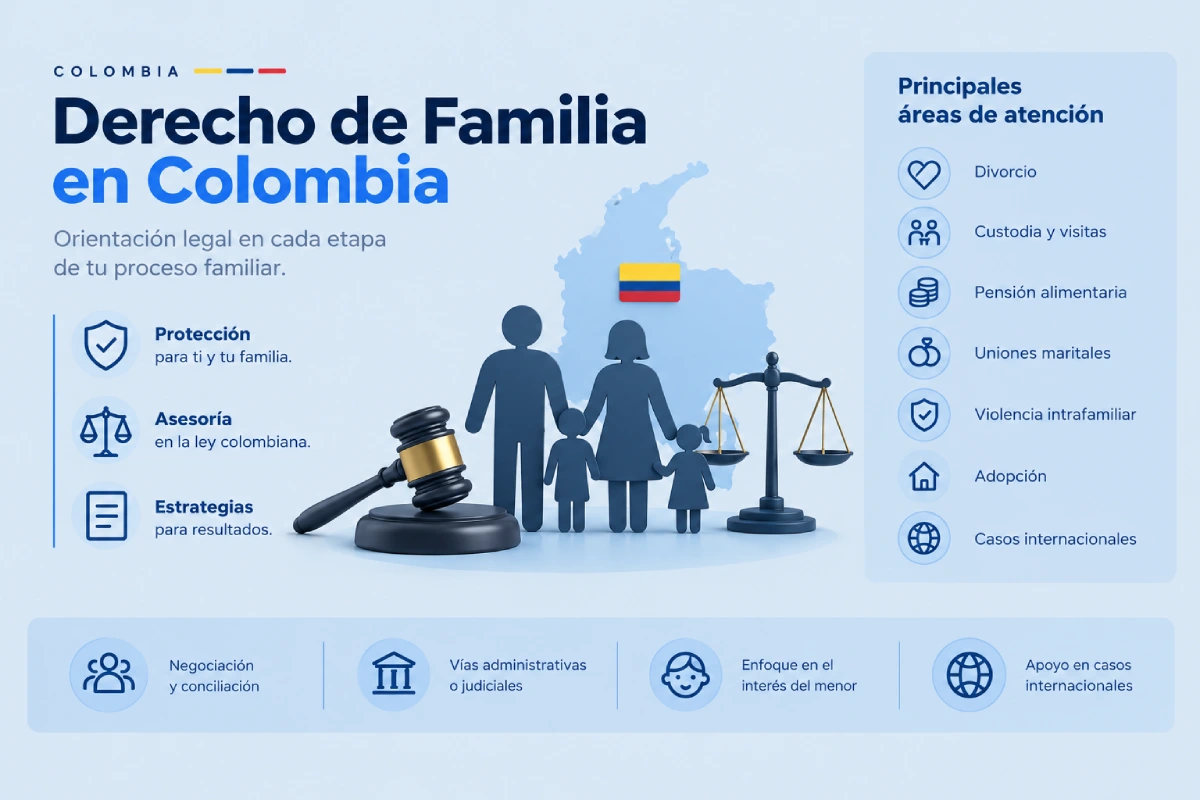
Family relationships can involve some of the most important legal decisions a person will ever make. Marriage, divorce, separation, child custody, visitation, child support, parental authority, domestic violence, property disputes, and international family matters can all create legal questions that are difficult to resolve without understanding Colombian law. For individuals and families facing these situations, working with a Colombian Family Law attorney can provide legal guidance tailored to the circumstances of the case.
Colombian family law combines constitutional protections, civil law, legislation concerning children and adolescents, procedural rules, and specialized family court procedures. The appropriate legal route depends on the nature of the dispute, whether the parties can reach an agreement, whether children are involved, and whether the matter has an international component. The Colombian Institute of Family Welfare (ICBF), for example, recognizes specific procedures for custody, visitation, and child protection, while the Ministry of Justice provides different legal routes for divorce, child support, marital unions, and other family matters.
For foreign nationals, Colombians living abroad, mixed-nationality families, and people who have assets or family members in more than one country, these issues can become even more complicated. A family lawyer must consider not only the immediate dispute but also documentation, jurisdiction, recognition of decisions, international travel, and the practical consequences of an agreement or court order.
What Colombian family law covers
Family law in Colombia encompasses a broad range of legal relationships involving spouses, permanent partners, parents, children, and other relatives. It is not limited to divorce. A family law practice may deal with the establishment or dissolution of family relationships, financial responsibilities, children’s rights, parental responsibilities, and disputes that arise when relationships change.
A Colombian Family Law attorney may assist clients with both negotiated solutions and contested proceedings. The appropriate strategy depends on whether the parties can communicate and agree or whether a court or administrative authority must intervene. In matters involving children, the child’s best interests are particularly important. The ICBF explains that decisions concerning custody and personal care must consider the circumstances of the specific case, the child’s comprehensive protection, and the principle of the best interests of the child.
Family law is broader than divorce
Divorce is one of the best-known family law matters, but it represents only one part of the field. Parents may require legal assistance with custody, visitation, child support, parental authority, relocation, or disagreements concerning education and healthcare.
Couples who are not married may also require advice. Colombian law recognizes marital unions in fact, known as unión marital de hecho, and provides procedures for declaring their existence and addressing associated property consequences. The Ministry of Justice explains that such a relationship can be declared by agreement before a conciliation center or notary, or through a family judge when the parties disagree.
Family disputes can involve several legal issues
A single family conflict may involve several interconnected questions. For example, a couple separating with minor children may need to address divorce, custody, visitation, child support, property, and travel arrangements at the same time.
This is why analyzing each issue separately can sometimes produce an incomplete solution. The legal consequences of one decision may affect another area of the family’s circumstances. A well-prepared legal strategy should therefore consider the family situation as a whole while identifying which matters require immediate action and which can be resolved through agreement.
When to consult a Colombian Family Law attorney
People sometimes wait until a family dispute becomes highly contentious before seeking legal advice. That can make the situation more difficult. Early legal guidance can help a person understand available options before signing an agreement, making a major relocation, beginning a court proceeding, or responding to a legal claim.
A Colombian Family Law attorney can explain which authority may have jurisdiction, whether conciliation is required, what documents should be collected, and whether the matter is appropriate for negotiation or litigation. The Ministry of Justice’s LegalApp similarly provides citizens with information about the authority to approach and the steps associated with different legal procedures.
Before signing a family agreement
A written agreement may appear straightforward, particularly when both parties are trying to separate amicably. However, the wording can have important consequences. An agreement concerning children, financial obligations, property, or visitation should be reviewed carefully before it is signed.
This is especially relevant when one party does not speak Spanish fluently or when the agreement will later need to be presented to authorities outside Colombia. A lawyer can identify ambiguous provisions, missing obligations, unrealistic schedules, or terms that may create problems later.
When the other party already has legal representation
If the other spouse or parent has hired a lawyer, obtaining independent legal advice can help ensure that the person’s interests are properly understood. Family law negotiations often involve unequal access to information about assets, income, property, or previous agreements.
Having separate representation does not necessarily mean that the case must become hostile. Independent lawyers can still work toward a negotiated resolution while ensuring that each person’s rights and responsibilities are clearly addressed.
Divorce in Colombia and the role of a family lawyer
Divorce can be handled through different legal routes depending on whether the spouses agree and on the circumstances of the marriage. When spouses reach a mutual agreement, Colombian law allows certain divorces to proceed through a notarial process with the participation of a lawyer. The Ministry of Justice states that a lawyer is required for a mutual-consent divorce before a notary.
When minor children are involved, the process requires additional consideration. The agreement must address matters such as custody, child support, and visitation. The Ministry of Justice explains that documents concerning the children and the relevant arrangements must be included in a mutual-consent divorce process.
Divorce by mutual agreement
A negotiated divorce can be more efficient when both spouses are able to agree on the important consequences of ending the marriage. The parties may need to address children, property, debts, and other financial matters before the divorce can be properly formalized.
The existence of an agreement does not mean that every detail should be treated casually. A poorly drafted agreement may leave important questions unanswered, particularly concerning future child expenses, property obligations, or the implementation of visitation arrangements.
Unilateral divorce
Colombian law also recognizes a unilateral divorce route. The Ministry of Justice explains that, under Law 2442 of 2024, one spouse may request divorce without the consent of the other spouse through a judicial proceeding. The Ministry states that this process requires a lawyer and is handled by a family judge.
This development is particularly important for people who want to understand their options when the other spouse refuses to cooperate. A family lawyer can explain the applicable procedure, evidence, financial consequences, and issues involving children or marital property.
Child custody and parental responsibility
Child custody is one of the most sensitive areas of family law because decisions can directly affect a child’s daily life. Colombian law distinguishes custody and personal care from parental authority. The ICBF explains that custody involves daily upbringing, education, guidance, protection, and decisions connected with the child’s everyday welfare.
A Colombian Family Law attorney can help a parent understand whether the situation calls for an agreement, conciliation, administrative intervention, or judicial proceedings. The ICBF indicates that custody matters can be initiated by parents, legal representatives, relatives, guardians, or people caring for the child, with the relevant ICBF center generally determined by the child’s place of residence.
The best interests of the child
The central principle in custody disputes is not which parent can present the strongest personal argument. Authorities must evaluate the child’s welfare, protection, and rights.
The ICBF explains that the competent authority must analyze the circumstances of each individual case and make decisions based on the child’s best interests and comprehensive protection.
This means factors such as the child’s living conditions, education, health, emotional relationships, family environment, and the parents’ ability to provide appropriate care may become relevant.
Custody and parental authority are different
Parents frequently confuse custody with parental authority. They are related but legally distinct.
The ICBF explains that parental authority involves legal representation and certain rights and duties concerning the child’s property and legal interests, while custody is associated more directly with daily care and upbringing.
A custody decision therefore does not automatically mean that the other parent loses every legal relationship with the child. A family lawyer can explain the distinction and determine whether a particular dispute concerns custody, visitation, parental authority, or several of these matters simultaneously.
Child visitation and family relationships
When parents no longer live together, maintaining the child’s relationship with both parents can become a major concern. Colombian authorities recognize visitation as a mechanism for preserving family relationships.
The ICBF explains that children and adolescents have a right to maintain contact with a parent with whom they do not live, and that visitation should promote affection, family unity, and strong family relationships.
A visitation arrangement can be established through an agreement, an administrative decision, or a judicial decision depending on the circumstances.
Creating a practical visitation schedule
A visitation agreement should be practical rather than vague. Parents may need to address weekdays, weekends, school vacations, holidays, birthdays, transportation, overnight stays, and communication when the child is not physically present.
The ICBF states that visitation can include physical or virtual contact and should consider the child’s needs and the visiting parent’s ability to provide appropriate care and protection.
A lawyer can help transform a general request for “more visitation” into a detailed arrangement that is easier to follow and enforce.
When visitation becomes disputed
If one parent prevents contact or the parents cannot agree, the matter may require formal intervention. The ICBF provides a conciliation procedure and explains that unresolved disputes may ultimately be taken before a Family Judge.
This is one reason early legal advice can be valuable. A parent should understand the existing order or agreement before taking unilateral action.
Child support and financial responsibilities
Child support is another central area of Colombian family law. Parents have financial responsibilities toward their children, and the amount of support is connected to the child’s needs and the parent’s economic capacity.
The Ministry of Justice explains that child support can cover daily sustenance, housing, clothing, education, medical care, and recreation. It also describes conciliation as an important route for establishing, increasing, decreasing, or addressing support obligations.
A Colombian Family Law attorney can help organize evidence concerning income, expenses, education, healthcare, and other relevant costs.
Establishing child support
Parents may attempt to reach an agreement concerning the amount and payment conditions. If an agreement cannot be reached, the competent authority may determine the obligation according to the circumstances.
The Ministry of Justice indicates that conciliation may be sought through several authorized institutions, including family authorities, conciliation centers, notaries, and other designated services.
A lawyer can help ensure that an agreement addresses not only the regular monthly payment but also extraordinary expenses that may arise.
Modifying an existing obligation
Financial circumstances can change. A parent may lose employment, experience a significant reduction in income, or face substantial new expenses. At the same time, a child’s needs may increase.
The Ministry of Justice explains that a reduction of child support can be requested through conciliation and, if necessary, through a Family Judge. It also emphasizes that an existing obligation should continue to be paid until it is legally modified.
This makes it important to seek formal modification rather than simply stopping payments.
Property and financial matters after separation
Family law can also involve substantial property questions. Married couples may need to address the dissolution and liquidation of the marital property regime when the relationship ends.
A family lawyer can help determine which assets may be relevant, what documentation is needed, and whether the matter can be resolved by agreement or requires judicial intervention.
Identifying marital assets
Property disputes can become complicated when assets were acquired at different times, registered in only one person’s name, inherited, financed through loans, or connected with businesses.
The legal analysis should therefore go beyond simply listing property that appears in one spouse’s name. Documentation, acquisition dates, debts, agreements, and the applicable property regime can all matter.
Separating family and business interests
Some couples operate businesses together or have interests in companies. Separation may therefore involve questions about ownership, management, debts, and the value of business interests.
A lawyer may need to coordinate family law analysis with financial or commercial documentation to understand the overall position of the parties.
Common law matters handled by family attorneys
The scope of family law is broad. Depending on the lawyer’s practice, clients may seek assistance with divorce, custody, visitation, child support, marital unions, property matters, parental authority, paternity, adoption, protective measures, and other family disputes.
The Ministry of Justice’s LegalApp recognizes family-related procedures covering areas such as divorce, child support, and family relationships.
Paternity and parent-child relationships
Questions concerning legal parentage can have consequences for custody, visitation, support, inheritance, and other rights.
Where parentage is disputed or needs to be legally established, the appropriate procedure depends on the circumstances and available evidence. DNA testing, civil registration records, and other evidence may become relevant.
A lawyer can determine which legal action is appropriate rather than assuming that every parentage dispute follows the same process.
Adoption and family formation
Adoption creates a permanent legal relationship and involves specialized procedures designed to protect the interests of children.
Because adoption is closely regulated, prospective parents should obtain advice from the appropriate authorities and professionals. The legal requirements can vary depending on whether the adoption is domestic or involves an international element.
Family law and domestic violence
Family law can intersect with situations involving domestic violence, threats, harassment, or other forms of abuse.
When safety is an immediate concern, the priority is protection rather than negotiation. Depending on the circumstances, protective measures and intervention by competent authorities may be necessary.
A lawyer can help explain available legal routes while the affected person seeks appropriate protection.
Protecting children during family disputes
Children can be affected by parental conflict even when they are not direct participants in the dispute.
Custody and visitation arrangements may need to incorporate safeguards when credible concerns exist regarding violence, abuse, neglect, or other risks.
The ICBF states that interference with established visitation should be based on serious and legitimate reasons connected with protecting the child’s best interests.
Documenting relevant incidents
When serious allegations exist, documentation can become important. Medical records, official reports, messages, photographs, witness information, school records, and other evidence may help establish the circumstances.
Parents should avoid fabricating or exaggerating allegations. Family authorities need reliable information to determine what measures, if any, are appropriate.
International family law in Colombia
International family matters can involve additional legal questions because family members may live in different countries.
For example, one parent may live in the United States while the child resides in Colombia. A Colombian citizen may marry abroad and later seek a divorce in Colombia. A couple may have assets in multiple jurisdictions. A child may be the subject of a custody dispute involving international travel.
These circumstances can require a Colombian Family Law attorney with experience analyzing cross-border issues.
Parents living outside Colombia
A parent living abroad may still need to participate in Colombian family proceedings.
The appropriate process depends on the nature of the matter, the child’s residence, the location of the other parent, existing Colombian decisions, and applicable international rules.
Communication and document requirements can also become more complicated when one party is outside Colombia.
International child travel
International travel involving children deserves particular attention.
A custody or visitation arrangement does not necessarily answer every question concerning travel documentation, parental authorization, or border requirements.
Before taking a child abroad, parents should verify the current requirements that apply to their circumstances and obtain legal advice when there is disagreement or an existing custody order.
Family law for foreigners in Colombia
Foreign nationals living in Colombia can encounter family law issues involving Colombian spouses, children, property, or immigration-related circumstances.
The fact that one person is a foreign citizen does not eliminate the need to understand Colombian family law when the relevant relationship or legal proceeding is connected to Colombia.
Mixed-nationality families
Mixed-nationality couples may have family relationships connected to more than one country. This can affect marriage records, divorce recognition, children’s nationality, travel, custody, and financial responsibilities.
The correct legal strategy depends on the specific facts. A lawyer should determine which country has jurisdiction and which documents need to be recognized, translated, legalized, or apostilled.
Families moving between countries
International relocation can create additional challenges for parents who share responsibility for a child.
A move may change the practical operation of custody, visitation, education, and support arrangements. These issues should ideally be addressed before the move rather than after a dispute develops.
How to choose a Colombian Family Law attorney
Choosing a family lawyer should involve more than searching for the first available professional online. Family law cases can involve confidential information, children, financial records, international documents, and emotionally difficult circumstances.
A potential client should consider whether the lawyer regularly handles the type of matter involved and whether the lawyer can communicate clearly about the available legal options.
Experience with the specific legal problem
A lawyer who primarily handles one type of case may not be the best fit for a matter involving several interconnected issues.
For example, an international custody dispute may require different knowledge from a straightforward uncontested divorce.
Clients should ask about experience with the particular circumstances rather than relying only on a general statement that the lawyer practices family law.
Communication and transparency
Good communication is particularly important in family proceedings.
Clients should understand what the lawyer is proposing, what documents are needed, what decisions require client approval, and what potential outcomes may exist.
Clear communication also helps prevent unrealistic expectations about how quickly a legal matter can be resolved.
Preparing for the first consultation
A first consultation becomes more useful when the client arrives with organized information.
The lawyer will typically need to understand the relationship between the parties, the relevant dates, whether there are children, where everyone currently lives, whether previous agreements or court decisions exist, and what the client wants to accomplish.
Documents to organize
Depending on the matter, useful documents may include civil registration records, marriage certificates, identification documents, previous agreements, court decisions, financial information, property records, school records, medical documentation, and relevant communications.
Not every document will be necessary in every case.
The purpose of preparing them is to give the lawyer enough information to identify the relevant legal issues and determine what additional evidence may be required.
Questions to ask your lawyer
Clients may want to ask which legal procedure applies, whether conciliation is required, which authority has jurisdiction, whether a lawyer is mandatory, what documents are needed, what risks exist, and what alternatives to litigation are available.
It is also reasonable to ask about legal fees and what services are included.
The Ministry of Justice provides LegalApp as an information resource for citizens seeking guidance about procedures and the authorities involved.
Negotiation and alternative dispute resolution
Not every family dispute needs to become a courtroom battle.
Conciliation can be particularly valuable in family law because it gives people an opportunity to reach an agreement while avoiding some of the uncertainty associated with litigation.
The Ministry of Justice identifies conciliation as a route for matters such as child support, while the ICBF uses conciliation in custody and visitation procedures.
Benefits of reaching an agreement
A negotiated agreement can allow parents or spouses to create arrangements specifically adapted to their circumstances.
Parents can establish detailed schedules for children, determine financial responsibilities, and clarify communication procedures.
An agreement can also reduce the amount of uncertainty associated with a contested court process.
When negotiation may not be appropriate
Negotiation is not suitable for every situation.
Where there is serious violence, coercion, intimidation, hidden assets, or an immediate risk to a child, the priority may be protection and formal intervention rather than attempting to compromise every issue.
A family lawyer can help determine whether negotiation is appropriate and whether additional safeguards are needed.
What happens when a family case goes to court
Court proceedings can be necessary when the parties cannot reach an agreement or when the law requires judicial intervention.
The exact procedure depends on the type of case. A divorce proceeding, custody dispute, property case, or support claim may follow different procedural rules.
Evidence and legal arguments
A court generally needs reliable evidence to evaluate disputed facts.
The lawyer’s role is not simply to tell the client’s story. Legal representation involves identifying the relevant facts, connecting them to the applicable law, presenting evidence properly, and developing arguments that support the client’s legal position.
Clients should therefore provide complete and honest information to their lawyer, including facts that may appear unfavorable.
Court orders and compliance
Once an authority issues a binding decision or approves a legally effective agreement, the parties should comply with its terms.
If circumstances change, the appropriate response is generally to seek a formal modification rather than simply ignoring the existing order.
This principle is particularly important for child support, custody, and visitation arrangements.
Legal fees and costs in family law
The cost of a family law matter depends on its complexity, the type of proceeding, the amount of work required, and whether the case can be resolved by agreement.
A simple negotiated matter may require substantially less legal work than a contested case involving multiple hearings, evidence, financial disputes, or international issues.
Questions about legal fees
Before retaining a lawyer, clients should ask how fees are calculated and which services are included.
Depending on the case, fees may be structured as a fixed amount, hourly billing, staged payments, or another arrangement agreed with the client.
Additional expenses can include notarial fees, registration costs, expert reports, document translations, certifications, travel, or other procedural expenses.
Access to legal assistance
Not every person can afford private legal representation. Colombian institutions provide alternative sources of legal orientation and assistance.
The Ministry of Justice notes that people seeking family-law information may be able to approach entities such as the Personería, Defensoría del Pueblo, Casa de Justicia, or university legal clinics depending on the matter and location.
Frequently asked questions about Colombian family law
Do I need a Colombian Family Law attorney for every family matter?
Not necessarily. Some procedures can be initiated without a lawyer, while others require legal representation. The specific requirement depends on the legal process.
For example, the Ministry of Justice states that a lawyer is required for a mutual-consent divorce before a notary and for the unilateral divorce procedure.
Even where representation is not mandatory, legal advice may still be useful when the matter involves children, substantial assets, international elements, or significant disagreement. A lawyer can help identify risks before a person commits to an agreement or procedure.
Can parents resolve custody without going to court?
Yes. The ICBF provides conciliation procedures for custody and personal care. Parents may reach an agreement concerning custody, visitation, and related responsibilities when circumstances allow.
If conciliation fails, the matter may proceed through the applicable administrative or judicial route. The appropriate procedure depends on the circumstances and whether there are concerns involving the child’s rights or safety.
Can visitation be established without a court case?
Yes. Parents can agree on visitation, and visitation can also be regulated through conciliation. The ICBF recognizes private agreements, administrative decisions, and judicial decisions as possible mechanisms for establishing visitation.
A formal arrangement can be particularly useful when parents anticipate future disagreements or live in different cities.
Can child support be modified?
Yes, when the circumstances justify a change. The Ministry of Justice explains that requests to decrease child support can first be addressed through conciliation and, if necessary, through a Family Judge.
However, a parent should not simply stop paying an existing amount because their circumstances have changed. A formal modification should be obtained through the appropriate legal mechanism.
Can a family lawyer help with international family matters?
Yes. A lawyer familiar with Colombian family law can help identify Colombian procedures that may apply to a family situation involving people living in different countries.
International matters can require additional analysis concerning jurisdiction, documentation, travel, recognition of decisions, and the relationship between Colombian law and foreign law.
Why legal strategy matters in family disputes
Family disputes are rarely limited to a single legal question. A separation involving children can simultaneously involve custody, visitation, support, property, relocation, and communication.
This is why legal strategy matters. The best approach is not necessarily to file the most aggressive possible claim. In many situations, a carefully negotiated agreement can provide greater stability than prolonged litigation.
A Colombian Family Law attorney can help evaluate the available routes and determine which issues should be negotiated, which require formal action, and which need immediate attention.
Protecting long-term interests
Family decisions can have consequences for years.
A poorly drafted custody arrangement may create repeated disputes. An incomplete property agreement may leave financial issues unresolved. An informal visitation arrangement may become difficult to enforce after one parent moves.
Thinking about long-term consequences allows the parties to create clearer solutions.
Putting children at the center
When children are involved, legal strategy should also consider their emotional and developmental needs.
The ICBF repeatedly emphasizes the child’s best interests and protection when authorities determine custody and related matters.
Parents should therefore avoid treating family proceedings solely as a competition between adults. The strongest legal solution is often the one that creates a stable and workable framework for the child’s future.
Final considerations when seeking family law assistance
Finding the right legal support can make an important difference when dealing with divorce, custody, visitation, child support, property disputes, or international family matters. Colombian family law contains different procedures depending on the circumstances, and the appropriate path is not always obvious at the beginning of a dispute.
A Colombian Family Law attorney can help a client understand the legal framework, identify the relevant authority, organize documentation, evaluate evidence, negotiate agreements, and represent the client when judicial intervention becomes necessary.
Official Colombian institutions such as the ICBF and Ministry of Justice also provide public information about many family procedures, including custody, visitation, child support, divorce, and marital unions.
For parents, the priority should be protecting the rights and welfare of their children while creating practical arrangements that can work over time. For spouses or partners, careful legal planning can help address property, financial, and personal issues in an orderly way.
Family law cases are highly dependent on individual facts. A procedure that works for one family may not be appropriate for another. Before signing important documents, moving a child, stopping support payments, or beginning a contested proceeding, obtaining advice based on the specific circumstances can help avoid unnecessary legal complications.
Colombian family law covers a wide range of matters
Including divorce, child custody, visitation, child support, parental authority, marital unions, property disputes, domestic violence, parentage, adoption, and international family situations.
A Colombian Family Law attorney can help clients understand which legal procedure applies, prepare evidence and documentation, negotiate agreements, and pursue judicial remedies when necessary.
Colombian authorities place particular importance on the best interests and protection of children in custody and visitation matters, while the Ministry of Justice provides different legal routes for divorce, child support, marital unions, and other family procedures.
Some matters can be resolved through negotiation or conciliation, while others require administrative or judicial intervention. International families may face additional questions involving jurisdiction, travel, documentation, and recognition of legal decisions.
Ultimately, effective family law assistance should combine a clear understanding of Colombian law with a practical strategy that protects the client’s legal interests and, when children are involved, promotes their stability, safety, and long-term welfare.